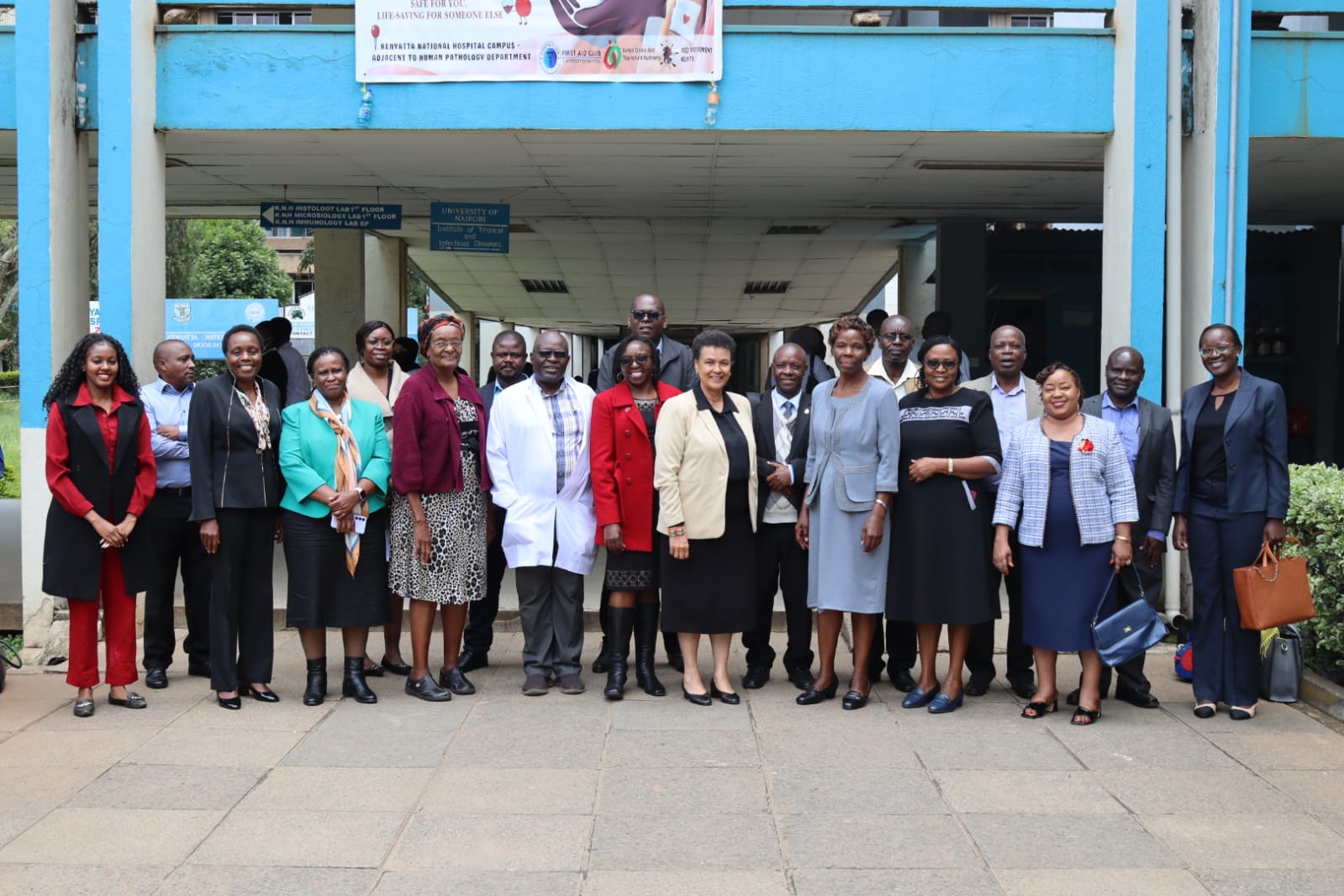
Advancing Processes on preparation on CBET at University of Nairobi
As Kenya moves steadily toward the transition to Competency-Based Education and Training (CBET) in higher education, universities are beginning to confront deeper questions about readiness, resources and the future of learning. While much of the national focus has been on basic education under CBC, universities are now preparing for the moment when the first CBC-trained students arrive at the tertiary level. What will university education look like then? Are institutions ready to align their programmes with competency-based learning? And how will universities ensure that graduates are prepared not just academically, but professionally and globally?
At the University of Nairobi, these questions are already driving a series of engagements across faculties as part of an ongoing CBET Faculty Needs Assessment exercise. The initiative forms part of a broader institutional effort to examine how existing programmes, teaching approaches and resources align with competency-based education. In doing so, the University is positioning itself as proactive and reform-driven, demonstrating leadership in academic transformation. The rollout also highlights the University’s role as a national benchmark for quality assurance and academic excellence. While the process is still unfolding, the engagements conducted so far offer an early glimpse into how universities are beginning to navigate this important shift.
Preparation for CBET at the University began as early as 2023, laying the groundwork for what has since developed into a structured, multi-stage implementation process. In 2024, the initiative formally took shape with alignment discussions involving the Faculty of Education, whose role in preparing teachers placed it at the center of the national shift toward competency-based learning. Around the same time, the University Senate approved the establishment of a CBET–CBI Committee tasked with guiding the transition across faculties.
The committee, chaired by Prof. Rosemary Imonje, has played a central role in coordinating the process alongside the University’s Quality Assurance team. Through sensitization sessions, policy discussions and structured faculty engagements, the committee has been working to ensure that academic units across the institution understand both the opportunities and responsibilities that come with competency-based education.
The current faculty needs assessment exercise represents the fourth step in a twelve-stage CBET implementation roadmap. Its purpose is to allow faculties to evaluate their readiness by examining their programmes, infrastructure, teaching resources and human capacity. At its core, the exercise encourages departments to reflect on how their existing curricula might align with competency-based outcomes. What has become clear through the discussions so far is that CBET is not being approached as a wholesale overhaul of university education, but rather as a careful alignment of existing programmes with clearly defined competencies.
The engagements began with the Faculty of Arts and Social Sciences, the University’s largest faculty. Discussions there highlighted the multidisciplinary nature of several programmes already in place, with departments such as information science, library studies and journalism demonstrating how academic fields increasingly intersect. Faculty members emphasized that curriculum design remains the foundation upon which resources, infrastructure and human capacity are built. In that sense, understanding CBET clearly becomes essential because how universities interpret the framework will ultimately determine how programmes evolve.
At the Faculty of Business and Management Sciences, the conversation turned towards how universities prepare students for life beyond graduation. Faculty members proposed the idea of introducing a common financial literacy and entrepreneurship course that could equip students with practical knowledge on investment, financial decision-making and economic realities. For many participants, CBET presents an opportunity to rethink what universities should teach, not only within specialized disciplines but also in the broader skills students need to navigate the world of work.
The discussion also raised questions about programme duration. With competency-based education emphasizing learning outcomes rather than strictly fixed timelines, some wondered whether certain programmes might eventually shift from four years to three. Yet this raises a different challenge in fields such as health sciences and the built environment, where professional training programmes already extend to five or six years. Could CBET create opportunities to streamline learning without compromising the depth required by professional standards?
Another factor shaping these conversations is the evolving relationship between senior school and university education. If key foundational content is already covered in Grade 11 and 12 under CBC, universities may need to reconsider how their programmes build on that knowledge rather than repeat it. However, this raises another question entirely: how will universities prepare when the full details of senior school curricula are still emerging?
At the Faculty of Health Sciences, discussions highlighted the practical realities that accompany academic reform. Community-based learning, an essential component of health training, has at times stalled due to transport challenges, a reminder that even the most ambitious curriculum frameworks must contend with logistical realities on the ground. Faculty members also raised concerns about evaluation criteria and assessment frameworks, noting that these structures may need further refinement to align effectively with CBET principles.
Discussions further pointed to misalignments within the CBET pathways themselves, including concerns that some essential subjects might become optional despite being fundamental for certain professions. Such observations inevitably lead to broader reflections on how pathways will be structured and whether universities will have sufficient insight into Grade 11 and 12 curricula to anticipate the learning backgrounds of incoming students.
When the engagements reached the Faculty of Built Environment, attention turned to the importance of aligning academic programmes with international and professional standards. Participants noted that competency-based education must do more than satisfy national policy expectations; it must also ensure that graduates are prepared to operate in professional environments that increasingly demand global competitiveness. This raises another important question: will CBET enable universities to produce graduates who meet both local and international expectations while maintaining the depth of professional training required in specialized disciplines?
Across the faculties visited so far, a common realization is emerging. CBET is not simply a technical adjustment to curricula. It represents an opportunity to rethink how universities prepare students for a rapidly changing world; one where adaptability, critical thinking and interdisciplinary understanding are becoming as important as disciplinary knowledge itself. The conversations taking place within lecture halls and faculty boardrooms are therefore part of a much larger national dialogue. At the same time, the engagements conducted so far represent only the beginning of a much larger process. The needs assessment exercise is ongoing, with the CBET committee and Quality Assurance team continuing to visit additional faculties across the University.
By engaging faculties in structured conversations about readiness, resources and curriculum alignment, the University of Nairobi is positioning itself at the forefront of this national transition. Yet as the University continues its preparations, the broader conversation continues to unfold. Are institutions across the country ready for the CBET era? Do they possess the infrastructure, tools and human capital required to sustain this shift? Most importantly, will this new framework succeed in preparing students not only academically, but holistically, for the complex world they will enter after graduation?
As Kenya approaches the first university intake of CBC graduates in the coming years, the answers to these questions may well determine the future of higher education in the country.